

Manufacturers across Canada face increasing demands for product traceability, quality assurance, compliance, and long-term durability. Whether producing aerospace components, heavy machinery, electrical equipment, automotive parts, or industrial tools, selecting the right part marking methods before production begins can significantly improve operational efficiency while reducing costly errors later in the manufacturing process.
Table of Contents
- Factors to Consider Before Choosing Part Marking Methods
- Common Part Marking Methods Used Across Industries
- Selecting Industrial Marking Products for Long-Term Performance
- The Importance of Traceability in Manufacturing
- Durable Product Identification for Manufacturers
- Industry Applications That Benefit from Permanent Part Marking
- Common Mistakes Manufacturers Should Avoid
- Future Trends in Part Marking
- Final Thoughts
- Frequently Asked Questions
- What are the most common part marking methods used in manufacturing?
- Why is permanent part marking important?
- Which industries benefit most from industrial marking products?
- How do I choose the right part marking method?
- Are industrial nameplates suitable for harsh environments?
- Can part marking improve inventory and asset management?
- Frequently Asked Questions
A well-planned part marking strategy supports inventory control, product identification, warranty management, maintenance scheduling, and regulatory compliance. Modern manufacturing environments also require permanent identification that withstands abrasion, chemicals, heat, moisture, UV exposure, and harsh industrial conditions without compromising readability.
Choosing the right solution is not simply about adding identification to a component. Manufacturers in Canada must consider material compatibility, production speed, marking permanence, environmental exposure, readability, barcode requirements, and lifecycle costs. Understanding these factors before production helps avoid unnecessary downtime and expensive rework. This guide explores the most effective part marking methods, explains where each technique performs best, and provides practical insights for manufacturers looking to improve traceability and production efficiency while investing in reliable industrial marking products.
Factors to Consider Before Choosing Part Marking Methods
Every production environment has unique requirements. Before selecting a marking solution, manufacturers should evaluate several important factors.
Material Type
Different materials respond differently to marking technologies. Examples include:
- Stainless steel
- Aluminium
- Brass
- Plastic
- Copper
- Painted metals
- Powder-coated surfaces
- Composite materials
The chosen marking technique should provide excellent contrast without damaging the component.
Environmental Conditions
Products may operate in challenging environments involving:
- High temperatures
- Outdoor exposure
- UV radiation
- Moisture
- Salt spray
- Industrial chemicals
- Heavy abrasion
- Constant vibration
Permanent marking solutions must remain readable throughout the product’s service life.
Production Volume
High-volume production often requires faster marking technologies that integrate seamlessly into automated manufacturing lines. Low-volume custom production may allow greater flexibility with specialized marking solutions.
Compliance Requirements
Many industries require permanent identification to satisfy quality and regulatory standards, including:
- Aerospace
- Defence
- Medical manufacturing
- Oil and gas
- Mining
- Transportation
- Industrial equipment
Selecting the appropriate part marking methods early helps manufacturers remain compliant while improving documentation and product tracking.
Common Part Marking Methods Used Across Industries
Several proven marking technologies serve different manufacturing applications. Understanding their strengths helps businesses make informed decisions.
Laser Marking
Laser marking has become one of the most widely used methods for precision manufacturing. Benefits include:
- Permanent identification
- High accuracy
- Excellent barcode readability
- Minimal maintenance
- Fast processing speeds
- No consumables
- High repeatability
Laser marking works exceptionally well for metal parts, electronic components, tools, machinery, and precision-engineered products. Applications include:
- Serial numbers
- QR codes
- Data Matrix codes
- Logos
- Product identification
- Compliance information
Dot Peen Marking
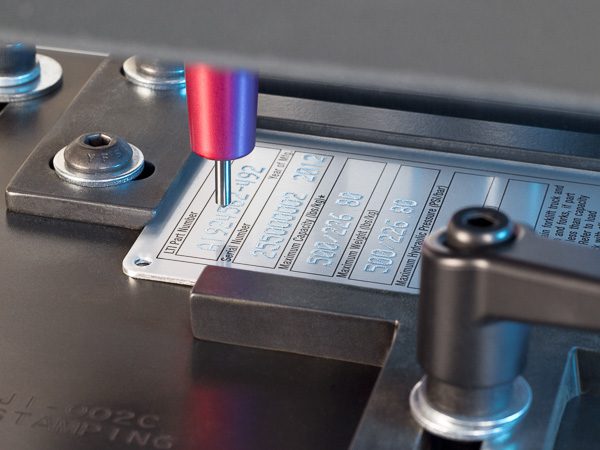
Dot peen technology creates permanent impressions using a hardened stylus. This process offers excellent durability for heavy-duty industrial applications. Advantages include:
- Deep permanent marks
- Excellent durability
- Suitable for rough environments
- Effective on metals
- Long service life
Industries frequently using dot peen include heavy equipment manufacturing, automotive production, and metal fabrication.
Chemical Etching
Chemical etching creates clean, permanent identification without placing excessive mechanical stress on delicate components. Common applications include:
- Medical instruments
- Precision equipment
- Control panels
- Thin metal components
This method provides sharp detail while preserving material integrity.
Inkjet Printing
Inkjet printing is suitable when temporary or semi-permanent identification is required. Typical applications include:
- Packaging
- Batch coding
- Manufacturing dates
- Production tracking
- Shipping information
Although economical for some operations, inkjet markings may not perform well in harsh industrial environments.
Engraving
Mechanical engraving remains a trusted solution for highly durable identification. Benefits include:
- Long-lasting readability
- Professional appearance
- Excellent permanence
- Suitable for equipment identification
Engraved information often includes:
- Asset numbers
- Manufacturer details
- Safety information
- Equipment specifications
Many industrial sectors continue using engraving because of its reliability over decades of service.
Selecting Industrial Marking Products for Long-Term Performance
Not all identification solutions perform equally under demanding operating conditions. Reliable industrial marking products should provide:
- High durability
- Corrosion resistance
- UV stability
- Abrasion resistance
- Chemical resistance
- Consistent readability
- Easy integration into production
Manufacturers should prioritize long-term performance rather than focusing solely on initial purchase costs. A durable marking solution often reduces replacement expenses while improving operational efficiency.
The Importance of Traceability in Manufacturing
Canadian manufacturers increasingly serve industries requiring complete lifecycle traceability. Examples include:
- Energy
- Infrastructure
- Food processing
- Transportation
- Aerospace
- Industrial automation
Permanent part marking improves product accountability while simplifying maintenance records and quality audits. Businesses investing in robust identification systems often experience better production visibility and reduced administrative complexity.
Durable Product Identification for Manufacturers
Many manufacturers combine permanent part marking with durable identification solutions to create complete traceability systems. Working with experienced suppliers such as Industrial Nameplates helps businesses choose marking technologies that match production requirements, environmental conditions, and compliance needs while improving long-term operational reliability.
Looking for dependable part marking methods for your manufacturing operation? Contact the team today to discuss durable, custom marking solutions that improve traceability, compliance, and long-term product identification.
Industry Applications That Benefit from Permanent Part Marking
Virtually every manufacturing sector relies on permanent part marking to improve product identification, compliance, and operational efficiency. Choosing suitable part marking methods helps organizations maintain quality standards while ensuring products remain identifiable throughout their service life.
Aerospace Manufacturing
Aircraft components require permanent identification capable of withstanding extreme temperatures, vibration, and long operational lifecycles. Laser marking and deep engraving are commonly selected because they provide highly durable and readable identification.
Automotive Industry
Vehicle manufacturers use part marking to identify engine components, transmissions, chassis parts, brake systems, and electrical assemblies. Permanent serial numbers and Data Matrix codes improve assembly accuracy, recall management, and aftermarket servicing.
Heavy Equipment and Construction
Construction machinery operates in harsh environments involving dirt, moisture, impacts, and corrosion. Durable industrial marking products help equipment owners identify replacement parts quickly while simplifying maintenance schedules.
Oil and Gas
Equipment used in oilfields and processing facilities must tolerate chemicals, salt spray, and extreme weather. Permanent identification supports equipment inspections, asset management, and regulatory compliance.
Electrical and Control Systems
Control panels, electrical enclosures, and industrial automation equipment require clear identification to improve installation, servicing, and workplace safety. Durable identification reduces confusion during maintenance and future upgrades.
Common Mistakes Manufacturers Should Avoid
Even experienced manufacturers occasionally overlook important considerations when selecting part marking methods. Avoiding these mistakes can improve long-term performance and reduce unnecessary costs.
- Choosing Based Only on Initial Cost: A low-cost marking solution may require frequent replacement or become unreadable under demanding conditions. Considering lifecycle value often delivers a better return on investment.
- Ignoring Environmental Exposure: Products exposed to chemicals, UV light, abrasion, or high temperatures require permanent identification designed specifically for those environments.
- Using Inconsistent Marking Standards: Standardizing part marking across production lines improves traceability, quality control, inventory management, and customer support.
- Overlooking Future Automation: Manufacturers adopting Industry 4.0 technologies should select marking systems compatible with barcode readers, scanners, and automated production equipment.
- Failing to Test Before Full Production: Pilot testing different part marking methods helps verify durability, readability, and production efficiency before full-scale manufacturing begins.
Future Trends in Part Marking
Manufacturing continues to evolve alongside digital technologies, making product identification more valuable than ever.
Emerging trends include:
- Smart factory integration
- Digital product traceability
- Machine-readable QR codes
- High-speed laser systems
- Automated verification systems
- Sustainable marking technologies
- Cloud-connected production records
- Enhanced lifecycle tracking
As industries continue embracing digital manufacturing, reliable part marking will remain essential for operational excellence and supply chain transparency.
Final Thoughts
Choosing the right part marking methods before production begins helps manufacturers improve traceability, reduce costly errors, and support long-term product performance. Whether producing industrial equipment, machinery, or precision components, investing in durable industrial marking products delivers lasting value. Businesses seeking dependable industrial nameplates can strengthen quality, compliance, and customer confidence by implementing an identification strategy built for demanding industrial applications.
Frequently Asked Questions
What are the most common part marking methods used in manufacturing?
The most common part marking methods include laser marking, dot peen marking, chemical etching, mechanical engraving, and inkjet printing. The best choice depends on the material, operating environment, durability requirements, and production process.
Why is permanent part marking important?
Permanent part marking improves traceability, quality assurance, maintenance, warranty management, and regulatory compliance. It also helps manufacturers quickly identify products throughout their operational lifecycle.
Which industries benefit most from industrial marking products?
Industries such as aerospace, automotive, heavy equipment, mining, oil and gas, manufacturing, transportation, electrical equipment, and industrial automation all rely on durable industrial marking products for reliable identification.
How do I choose the right part marking method?
Evaluate factors including component material, environmental exposure, production volume, required durability, barcode needs, and applicable industry standards. Testing multiple solutions before production helps identify the most effective option.
Are industrial nameplates suitable for harsh environments?
Yes. High-quality nameplates are designed to withstand moisture, corrosion, UV exposure, chemicals, temperature fluctuations, and heavy industrial use while maintaining clear, long-lasting identification.
Can part marking improve inventory and asset management?
Absolutely. Permanent identification allows manufacturers to track assets accurately, streamline inventory management, simplify maintenance records, and improve operational efficiency across the supply chain.
Don’t leave product identification to chance. Invest in dependable part marking methods that help manufacturers improve quality control, simplify asset tracking, and ensure lasting readability.


